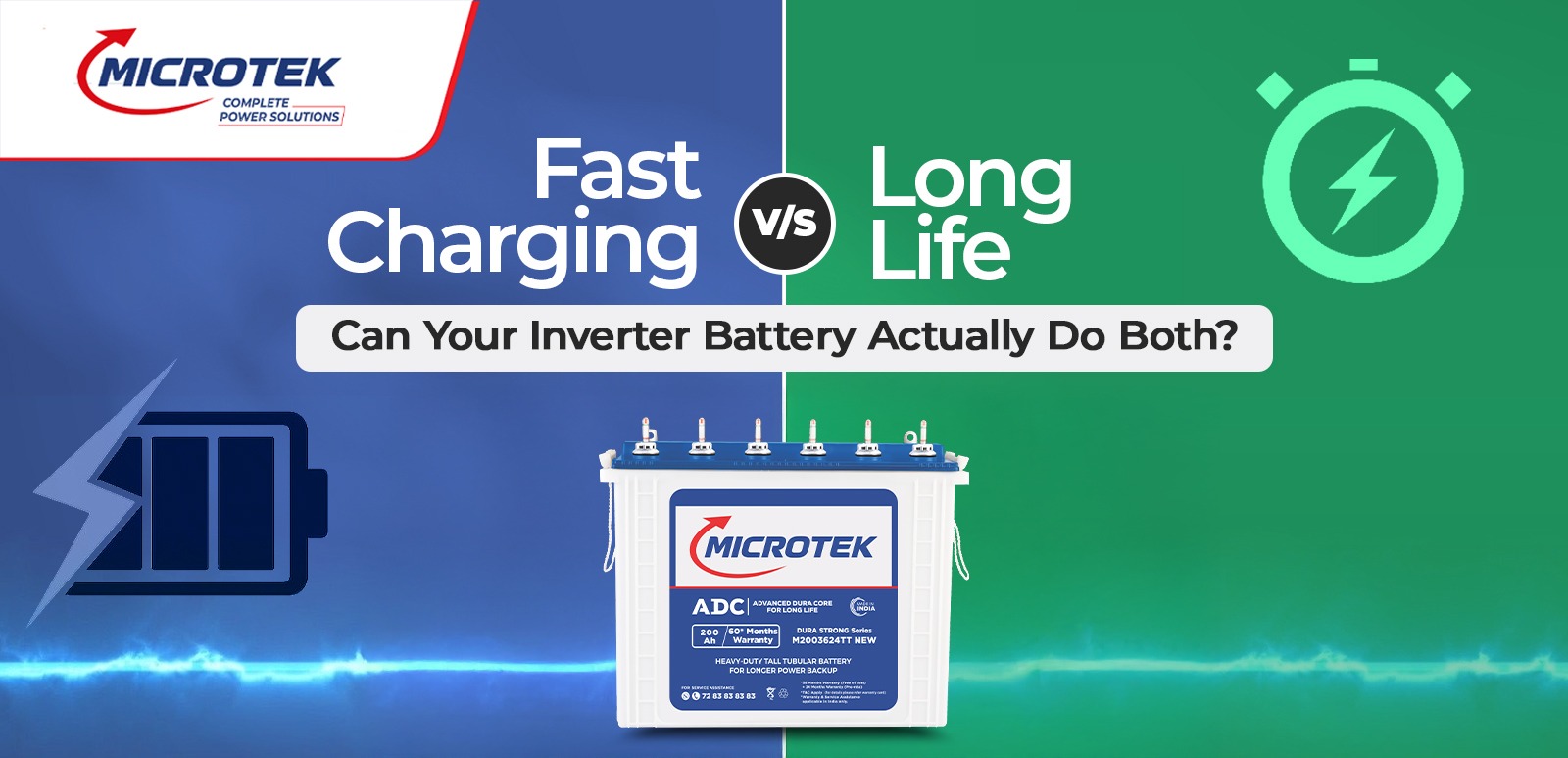
Fast Charging vs. Long Life: Can Your Inverter Battery Actually Do Both?
When a power cut hits, two things matter most about your inverter battery: how quickly it recharges when power returns, and how long it keeps running before the next recharge is needed. Many people assume these two qualities work against each other — but modern battery technology has changed this completely.
Understanding Fast Charging
Fast charging means the battery restores its stored power quickly when mains electricity comes back. This is critical in areas where power is only available for short windows — the faster the battery charges, the more backup energy it stores before the next outage.
Why Fast Charging Matters:
- In areas with 2–4 hour power availability, a slow-charging battery may never fully charge
- A fully charged battery provides maximum backup duration
- Faster charging means less time worrying about whether the battery is ready
Understanding Long Battery Life
Long life refers to two things: backup duration per charge (how many hours it runs), and overall lifespan (how many years before replacement). Both are important for the economics of home power backup.
What Affects Backup Duration:
- Battery capacity (Ah rating): Higher Ah = longer backup
- Connected load (watts): Fewer appliances running = longer backup
- Battery efficiency: Higher efficiency = more usable energy per charge
- Battery age and health: Degraded batteries hold less charge
Can a Battery Do Both? Yes — Here's How
Lithium Iron Phosphate (LiFePO4) Technology
Modern LiFePO4 batteries are engineered to deliver both fast charging and long service life simultaneously. Here's why:
- High charge acceptance rate: LiFePO4 cells can accept charge rapidly without the thermal stress that damages traditional batteries
- 3,500–5,000+ cycle life: The chemistry handles frequent fast-charge cycles without degradation
- Smart BMS (Battery Management System): Actively balances charging across cells, preventing damage during rapid charging
- SyncCharge Technology: Optimises communication between the inverter and battery during charging for maximum efficiency
Why Traditional Batteries Struggled With This Balance
Older lead-acid batteries faced a genuine trade-off. Fast charging generated heat, which damaged the plates and shortened lifespan. Battery manufacturers had to choose between charging speed and longevity. LiFePO4 chemistry fundamentally changes this equation.
Practical Comparison
| Factor | Lead-Acid Tubular | LiFePO4 Lithium |
|---|---|---|
| Full Charge Time | 8–12 hours | 3–5 hours |
| Cycle Life | ~2,000 cycles | 3,500–5,000+ cycles |
| Efficiency | 80–85% | 95–98% |
| Fast Charge Impact on Life | Significantly reduces life | Minimal impact with BMS |
| Depth of Discharge | 50% (safe limit) | 80–100% |
The Bottom Line:
Modern LiFePO4 lithium batteries genuinely deliver both fast charging and long service life — thanks to stable cell chemistry, smart BMS protection and intelligent charging technology. The old trade-off no longer applies.
Choosing the Right Battery for Your Needs
If your area has short power availability windows and frequent outages, fast charging is critical — a lithium battery is clearly the better choice. If you primarily need long backup duration and minimal maintenance, lithium also wins on both counts versus comparable lead-acid options.
Frequently Asked Questions
Q. Does fast charging shorten a lithium battery's life?
No — LiFePO4 batteries with a proper BMS handle fast charging without significant degradation. The BMS manages cell temperature and balance throughout the charge cycle.
Q. How much faster does a lithium battery charge compared to lead-acid?
Typically 2–3 times faster. A battery that takes 10 hours to charge in lead-acid format may charge fully in 3–4 hours with lithium.
Q. Can I use the same inverter for a lithium battery upgrade?
Many modern inverters are lithium-compatible. Check your inverter's specifications or consult the manufacturer before upgrading.